/WRITING · PEOPLE & AI
TIME100 AI 2026: who is steering AI beyond the usual names
TIME's fourth TIME100 AI list still features Altman, Amodei and Musk. The more interesting story is who else made it: Chinese lab founders, a UN agency head, a labour leader and an actor. Influence over AI has spread far beyond the people who train the models.
Lists of influential people are easy to dismiss and hard to ignore. TIME's annual TIME100 AI, now in its fourth year and published on 27 August 2026, is worth reading not for the rankings but for the shape of the list. The obvious names are there. The surprising ones tell you where the decisions about AI are actually being made.
What happened
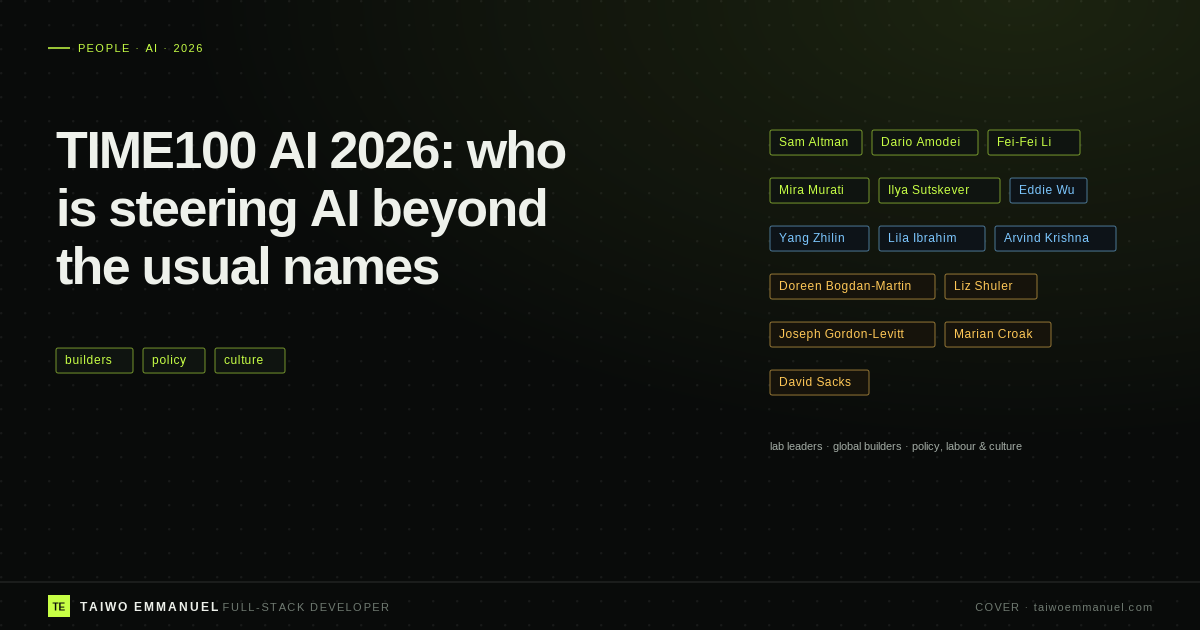
TIME describes its honourees as leaders, innovators, shapers and thinkers. The 2026 cover features 17 of them, including OpenAI's Sam Altman, Anthropic's Dario Amodei, xAI's Elon Musk, Jeff Bezos, Larry Ellison, Fei-Fei Li, Thinking Machines Lab's Mira Murati, Ilya Sutskever and Alibaba's Eddie Wu. Alongside them sit people who have never trained a model: Doreen Bogdan-Martin, who leads the UN's International Telecommunication Union; Liz Shuler, president of the AFL-CIO; investor and policy figure David Sacks; and actor Joseph Gordon-Levitt.
Editor-in-chief Sam Jacobs framed the year this way: "The activity in AI has been explosive and divisive, filled with big promises and big fears. The individuals on the 2026 TIME100 AI reflect the tumultuous state of this field."
Why it matters
The list shows influence over AI splitting into three groups.
- Builders who control frontier models and the capital behind them. Their decisions about what to release, at what price and with what safeguards still set the pace.
- Global builders outside Silicon Valley. Coverage of the list highlighted Chinese figures such as Alibaba's Eddie Wu and Moonshot AI's Yang Zhilin, whose open-weight Kimi models compete directly with Western labs on coding and agent tasks.
- People who shape the rules and the reaction: telecom standards bodies, labour unions, policymakers and public figures. Their influence comes from deciding how AI is governed, adopted and perceived, not from writing code.
That third group is growing because AI has moved from a research topic to a political and economic one. Layoffs attributed to AI, copyright disputes, energy demand and elections all pull in people whose leverage is votes, contracts and public opinion.
A closer look
Two names show how influence has shifted. Mira Murati, former CTO of OpenAI, now leads Thinking Machines Lab and was one of TIME's interviewees, representing a generation of leaders building new labs rather than joining existing ones. Yang Zhilin, founder of Moonshot AI, represents the open-weight strategy: releasing trillion-parameter models whose weights anyone can download, which changes who can build competitive AI products and where.
For developers in places such as Lagos, Nairobi or São Paulo, the second shift matters most. Open-weight models from a wider set of labs mean that access to capable AI depends less on a single provider's pricing or regional availability.
Takeaway
- TIME100 AI 2026 still centres frontier-lab leaders, but its most telling entries are policymakers, labour leaders, standards bodies and culture figures.
- Chinese builders such as Eddie Wu and Yang Zhilin feature prominently, reflecting how competitive open-weight models have become.
- Influence over AI now runs through governance and public opinion as much as through code; builders should track both.
References
- 1. TIME reveals the 2026 TIME100 AI list of the world's most influential people in artificial intelligence — TIME, 27 August 2026
- 2. TIME100 AI 2026 shows who is really shaping artificial intelligence — NewBits, August 2026
- 3. TIME releases 2026 TIME100 list of influential people in AI — Crypto Briefing, August 2026