/WRITING · PEOPLE & AI
Jensen Huang and robotics' 'ChatGPT moment': what CES 2026 actually showed
At CES 2026 Nvidia's CEO framed physical AI as robotics' ChatGPT moment. The press release said it 'is here'; on stage he said 'nearly here'. That gap is the most honest summary of where robots stand, and the most useful thing for builders to understand.
Jensen Huang has a talent for naming eras. He called the GPU the engine of deep learning long before most people believed it, and he turned Nvidia into the company the entire AI industry depends on. So when he took the stage at CES in Las Vegas on 6 January 2026 and talked about a "ChatGPT moment" for robotics, the industry listened.
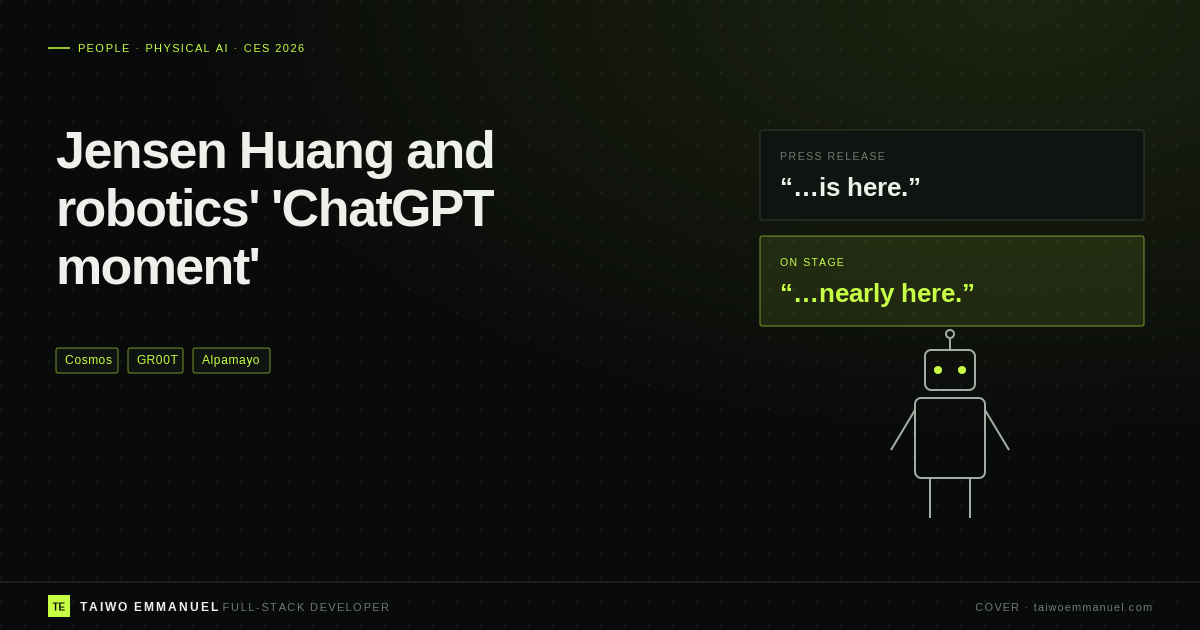
The detail worth noticing is the wording. Fortune reported that Nvidia's press release quoted Huang saying "the ChatGPT moment for robotics is here". In the keynote itself, he was more measured: the moment for physical AI was "nearly here". That small difference captures the state of robots in 2026 better than any demo.
What happened
Physical AI is Nvidia's term for models that perceive, reason about and act in the real world: robots, autonomous vehicles and machines in factories. At CES 2026 Nvidia announced or expanded several pieces of that stack. Cosmos and GR00T provide open models and data for robot learning and reasoning. Alpamayo is an open family of models, simulation tools and datasets aimed at the rare, complex scenarios that trip up autonomous vehicles. And Vera Rubin, Nvidia's latest GPU platform, was reported as fully in production.
Fortune listed partners including Boston Dynamics, Caterpillar, Franka Robotics, LG Electronics and NEURA Robotics debuting machines built on Nvidia technology. Coverage across the industry singled out Boston Dynamics' redesigned Atlas humanoid as a highlight of the show.
On stage Huang named the core difficulty plainly: "The challenge is clear. The physical world is diverse and unpredictable."
Why it matters
Huang's framing is strategic as much as technical. Nvidia sells the tools: the chips, the simulation platforms and increasingly the foundation models. If physical AI becomes the next wave of demand after chatbots, Nvidia wants to be its default supplier, just as it became the default supplier for training language models.
But a tool supplier's optimism is not the same as deployment. As Fortune's analysis pointed out, Nvidia does not build the robots or the cars. Robotics companies still have to make machines that do physical tasks reliably, safely and at a cost customers will pay, and automakers face regulators and public acceptance. That work is slow and capital-intensive, and faster AI progress alone does not solve it.
A closer look: who Jensen Huang is in this story
Huang co-founded Nvidia in 1993 and has led it ever since, making him one of the longest-serving founder-CEOs in technology. His pattern is to place long bets on computing platforms years before the market arrives: CUDA for general-purpose GPU computing, then deep learning, then data-centre AI. Physical AI is the next bet in that sequence, and CES 2026 was its most public pitch so far.
For builders, the practical signal is in the open releases. Open robotics models, simulation tools and datasets lower the cost of experimentation for start-ups and researchers who could never afford to collect years of real-world robot data. Whether the "moment" arrives in 2026 or later, the barrier to trying has dropped.
Takeaway
- At CES 2026 Nvidia pushed physical AI with Cosmos, GR00T, Alpamayo and the Vera Rubin platform, alongside robots from partners such as Boston Dynamics.
- The press release said robotics' ChatGPT moment "is here"; on stage Huang said "nearly here". The second is the honest status.
- Tools are arriving faster than deployments. The hard part is reliability, safety and cost in messy real environments.
- Open models and simulation lower the barrier to entry, which is the most immediate change for builders.
References
- 1. Nvidia's Jensen Huang on robotics' 'ChatGPT moment' — Fortune, 6 January 2026
- 2. Robots prepare for their 'ChatGPT moment' — The Deep View, January 2026
- 3. CES 2026: physical AI moves from concept to deployment — Physical AI newsletter, January 2026
- 4. The last word: a Dallas AI entrepreneur's take on robotics' 'ChatGPT moment' at CES 2026 — Dallas Innovates, January 2026