/WRITING · NIGERIA · INFRASTRUCTURE
Nigeria's AI data-centre race meets the power grid: what builders should design for
MTN, Airtel, Kasi Cloud, Equinix and new entrants are building AI-ready data centres in Lagos, and INFRAGORA plans up to $1 billion more. Power, skills and data-protection rules will decide how fast that capacity arrives. Here is the state of play and how I design products for Nigerian users in the meantime.
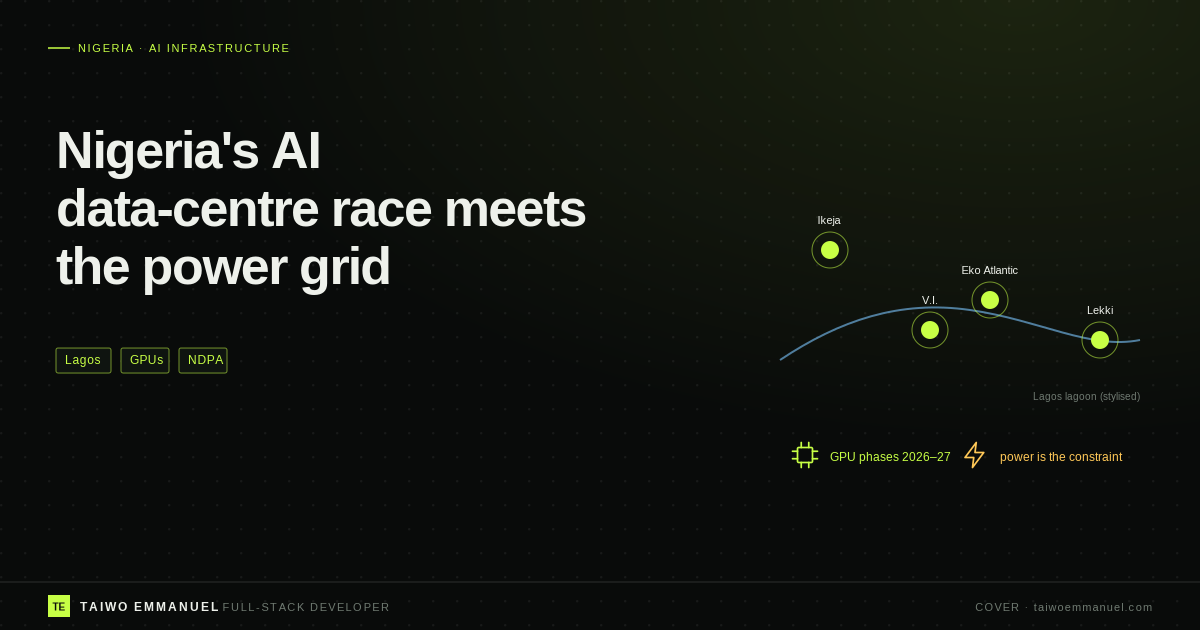
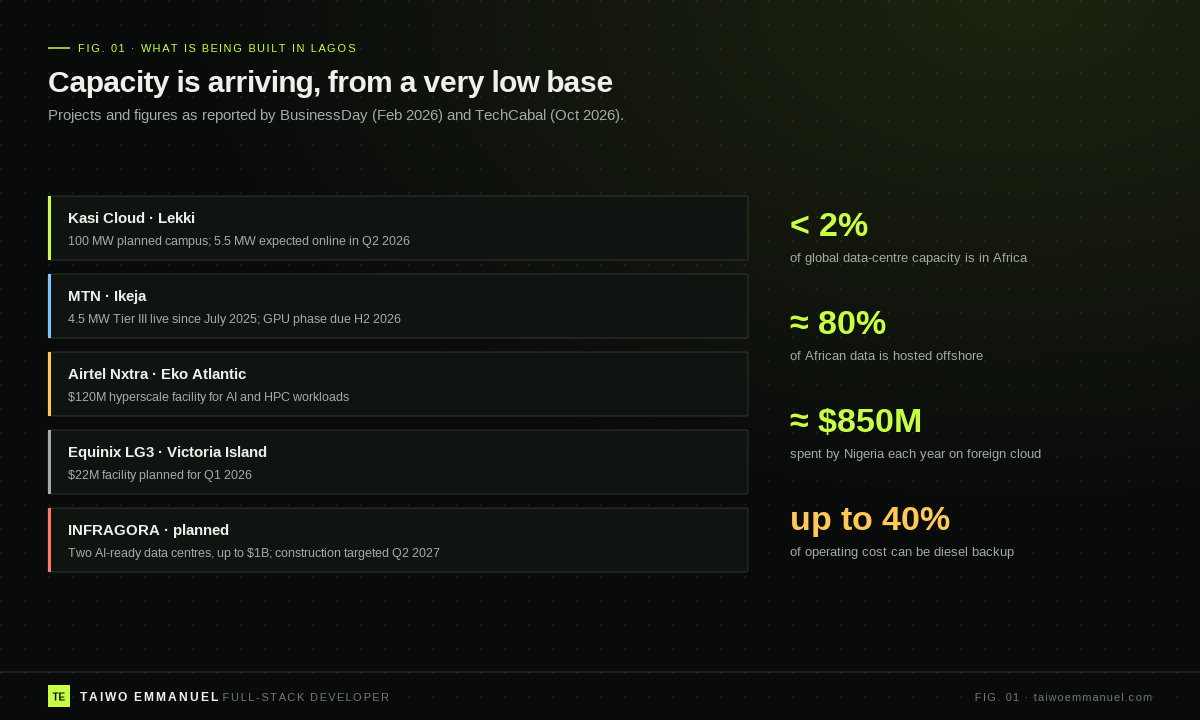
Every AI product runs somewhere. For most Nigerian users today, that somewhere is a data centre in Europe, North America or South Africa. BusinessDay reported in February that roughly 80% of African data is hosted offshore and that Nigeria spends about $850 million a year on foreign cloud services. That distance shows up as latency, as foreign-exchange exposure for businesses paying in dollars, and as questions about where personal data lives.
2026 is the year that started to change, at least on paper. Here is what is being built, what is holding it back, and how I design products for Nigerian users while the infrastructure catches up.
The problem: compute is far away and power is unreliable
AI workloads need dense racks of GPUs, and those need large amounts of stable electricity and cooling. Nigeria's grid cannot yet guarantee that. Industry voices quoted by BusinessDay said diesel backup can account for up to 40% of a facility's operating costs, and Vertiv's Wilson Eigbadon described grid supply in many African markets as too unstable for AI infrastructure, proposing hybrid gas, solar and battery systems instead.
The continental numbers frame the gap: Africa has about 18% of the world's population but under 2% of global data-centre capacity and under 1% of compute, according to the same report. Kasi Cloud's Johnson Agogbua went further, arguing that training and retaining specialised engineers may be a deeper bottleneck than power.
What is being built
The projects are real and concentrated in Lagos. MTN's Sifiso Dabengwa data centre in Ikeja, a 4.5 MW Tier III facility, began operating in July 2025, with a second phase adding AI-optimised GPU infrastructure due in the second half of 2026 at an estimated $240–250 million. Kasi Cloud is building a campus in Lekki planned for up to 100 MW, with 5.5 MW expected online in the second quarter of 2026. Airtel's Nxtra is developing a $120 million hyperscale facility at Eko Atlantic for high-performance and AI workloads, and Equinix planned to open its $22 million LG3 site on Victoria Island in early 2026.
New entrants are arriving too. TechCabal reported in October that INFRAGORA plans two AI-ready data centres in Nigeria in an investment worth up to $1 billion, with construction targeted for the second quarter of 2027. NITDA's director-general, Kashifu Inuwa Abdullahi, has framed AI as a greenfield opportunity for sectors such as agriculture and health.
The insight: design for the network you have, not the one being announced
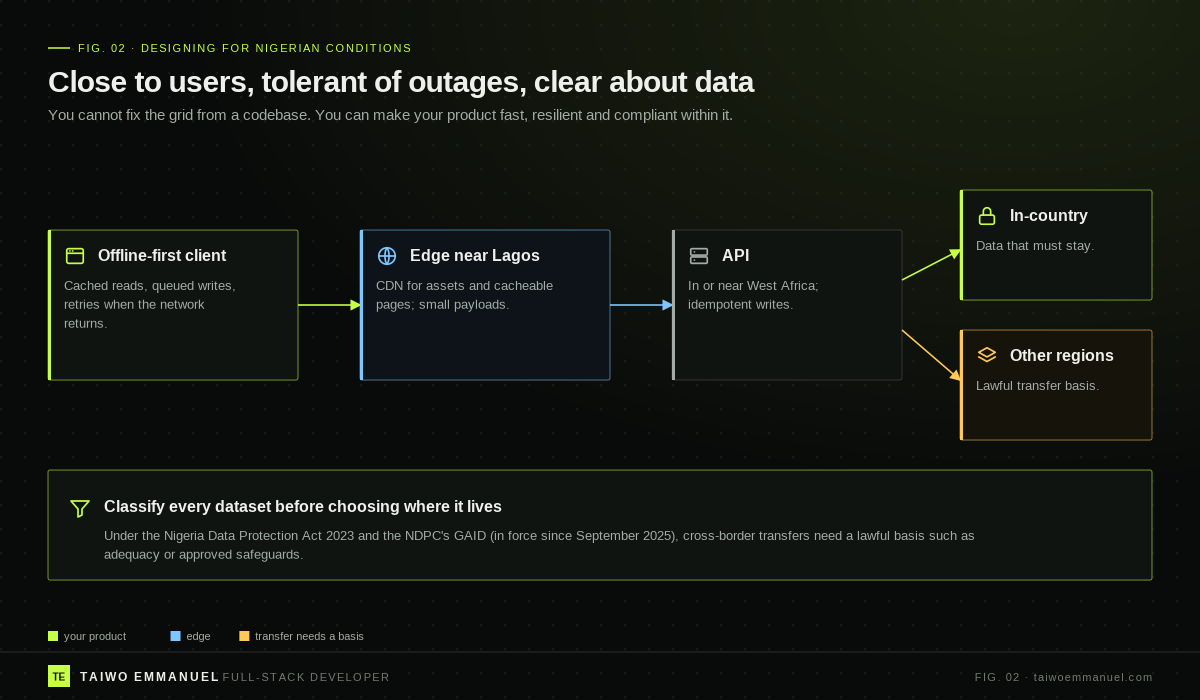
Local GPU capacity will help AI products serving Nigerians, especially for latency-sensitive features and data that should stay in the country. But announcements take years to become reliable capacity, and the grid will not be fixed by a data centre. Products shipping today should assume variable connectivity, distant compute for heavy AI work, and clear rules about which data may leave Nigeria.
That last point is a legal requirement, not just good practice. The Nigeria Data Protection Act 2023 and the Nigeria Data Protection Commission's General Application and Implementation Directive, in force since 19 September 2025, require a lawful basis, such as an adequacy decision or approved safeguards, for transferring personal data abroad.
Implementation walkthrough
Step 1: classify data before choosing regions
 TAIWO EMMANUEL / CODE NOTE
export type Residency = "in-country" | "transfer-with-basis" | "anywhere";

// Decide once, review with your DPO/counsel, enforce everywhere.
export const dataClasses = {
  bvnAndIdentity: { residency: "in-country", note: "Sensitive identifiers" },
  customerProfiles: { residency: "transfer-with-basis", note: "Personal data under NDPA" },
  aiPromptLogs: { residency: "transfer-with-basis", note: "May contain personal data; redact before sending abroad" },
  productAnalyticsAggregated: { residency: "anywhere", note: "No personal data" },
} satisfies Record<string, { residency: Residency; note: string }>;
Step 2: make the client tolerant of disconnection
For a React app, TanStack Query already has the building blocks. Mutations made while offline are paused and resumed when the connection returns; persisting the cache keeps the last good data on screen after a reload. Combined with idempotent APIs, users can keep working through flaky connections without duplicate side effects.
TAIWO EMMANUEL / CODE NOTEimport { QueryClient } from "@tanstack/react-query";
import { persistQueryClient } from "@tanstack/react-query-persist-client";
import { createSyncStoragePersister } from "@tanstack/query-sync-storage-persister";
export const queryClient = new QueryClient({
defaultOptions: {
queries: { networkMode: "offlineFirst", staleTime: 60_000, gcTime: 24 * 60 * 60 * 1000, retry: 3 },
mutations: { networkMode: "offlineFirst", retry: 5, retryDelay: (n) => Math.min(30_000, 1000 * 2 ** n) },
},
});
// Keep the last good data across reloads (only non-sensitive queries; see data-classes.ts).
persistQueryClient({
queryClient,
persister: createSyncStoragePersister({ storage: window.localStorage }),
maxAge: 24 * 60 * 60 * 1000,
dehydrateOptions: { shouldDehydrateQuery: (q) => q.meta?.persist === true },
});Notice the opt-in persistence: only queries explicitly marked with meta.persist are written to the device, which keeps balances, identity data and anything sensitive out of local storage, the same rule I described in my post on client-state rules for financial UIs.
Step 3: keep payloads small and assets close
Serve static assets and cacheable pages from a CDN with points of presence in or near Lagos, compress and resize images on upload, and set a performance budget for the first load measured on a mid-range Android phone over a mobile connection. For AI features, stream responses so users see progress immediately even when the model runs far away.
Takeaway
- Lagos is gaining AI-ready capacity: MTN Ikeja's GPU phase, Kasi Cloud Lekki, Airtel Nxtra Eko Atlantic, Equinix LG3 and INFRAGORA's planned $1 billion investment.
- Power reliability and specialist skills are the binding constraints, and announcements take years to become stable capacity.
- Build for today's conditions: classify data for NDPA compliance, keep assets near users, make clients offline-tolerant, and stream AI output.
Project figures reflect reporting as of 2 November 2026 and may change as projects progress. This is not legal advice on the NDPA.
References
- 1. Nigeria races toward AI data centre ambitions amid energy gaps — BusinessDay, 23 February 2026
- 2. Nigeria to get two new data centres in a $1bn investment — TechCabal, 26 October 2026
- 3. Will Nigeria get its first AI data centre in 2026? — TechCabal, 8 January 2026
- 4. From principles to practice: operationalizing Nigeria's Data Protection Act through the GAID — IAPP, 2025
- 5. Data protection laws of the world: Nigeria — DLA Piper
- 6. Network mode — TanStack Query docs
- 7. persistQueryClient — TanStack Query docs