/WRITING · NIGERIA · STARTUPS
Nigeria reclaims Africa's startup-funding crown, and why concentration matters
Nigerian startups raised about $635 million from January to September 2026, up 157% year on year and enough to top Africa for the first time since 2022. Four deals, led by Moove's $250 million, made up most of it. What the rebound means for founders and builders.
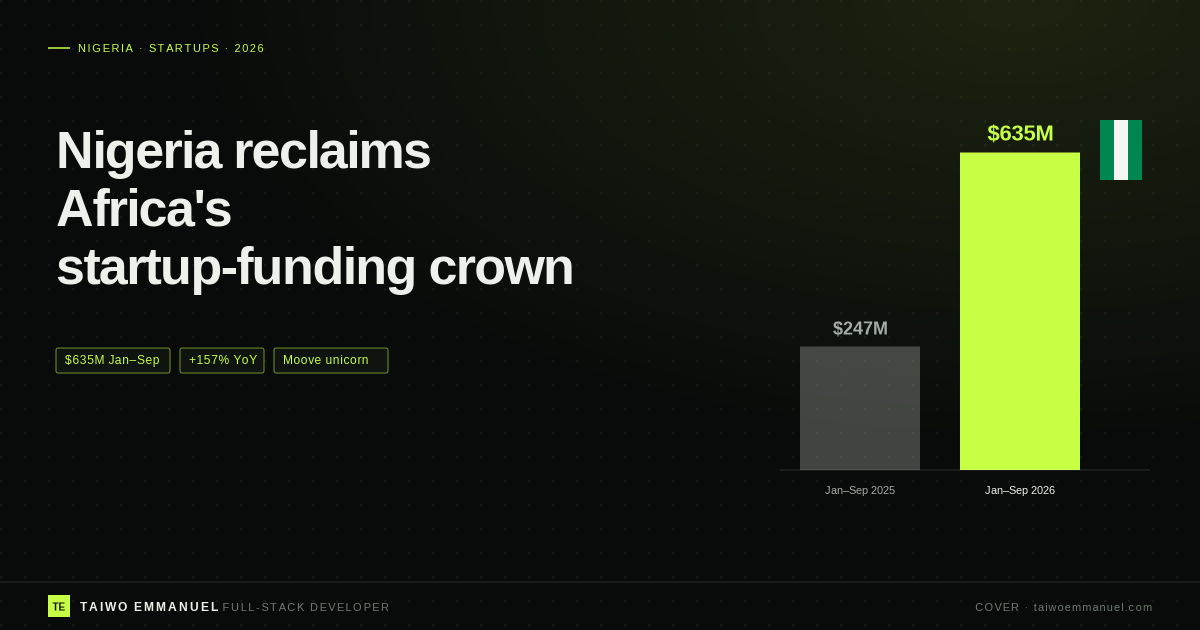
For three years the story of Nigerian tech funding was a hangover: the 2021 boom, then a steep fall as global investors pulled back and the naira lost value. In 2026 the numbers turned. According to figures reported by Further Africa in October, Nigerian startups raised about $635 million between January and September, up from $247 million in the same period of 2025, a 157% increase. That was enough to put Nigeria back at the top of Africa's funding rankings for the first time since 2022.
As someone who builds software in and for this market, I find the headline encouraging and the detail more useful.
What happened
The largest single deal was Moove, the Nigerian-founded mobility fintech that finances vehicles for ride-hailing drivers and is now headquartered in Dubai. On 5 August it announced a $250 million Series C at a $2.1 billion valuation, making it Africa's newest unicorn. Africa: The Big Deal ranked it as the second-largest equity round by an African start-up in 2026 at that point, just behind Spiro's $270 million in June.
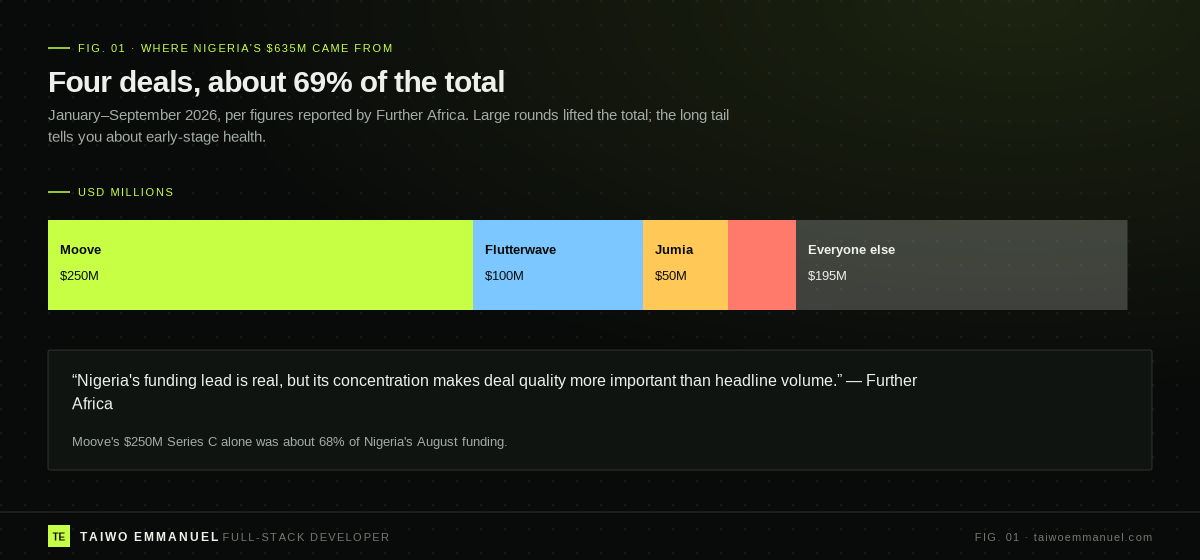
Further Africa listed three other large rounds behind Nigeria's total: Flutterwave ($100 million), Jumia ($50 million in post-IPO equity) and Yellow Card ($40 million). Flutterwave's raise came as part of a Series E that TechCabal reported valued the company at about $3.25 billion, with Ripple taking an equity stake. Capital went mainly to transport, logistics and payments.
Why it matters
A rebound led by mature companies is still a rebound. Large rounds for Moove and Flutterwave signal that global investors, including sovereign funds and strategic partners, are willing to back Nigerian-founded companies at scale again. That matters for hiring, for secondary sales that recycle money into new start-ups, and for the confidence of the next generation of founders.
But concentration cuts both ways. Remove the four largest deals and roughly $195 million remains for every other Nigerian start-up over nine months. Further Africa put it well: Nigeria's funding lead is real, but its concentration makes deal quality more important than headline volume. Founders raising a seed or Series A round should benchmark against that long tail, not the headline.
A closer look
Two structural points are worth watching. First, several of the biggest "Nigerian" companies now have holding companies or headquarters abroad, Moove in Dubai and others in the US or UK, which is how they access global capital. That is normal, but it means headline country rankings can move with a few corporate decisions.
Second, the money followed infrastructure. Payments, open banking and stablecoin rails (Flutterwave's acquisition of Mono and its partnership with Ripple), and asset financing (Moove) are foundations that other start-ups build on. If those foundations get stronger and cheaper, the long tail of smaller companies benefits even when it does not appear in the funding totals.
Takeaway
- Nigerian start-ups raised about $635 million from January to September 2026, up 157%, topping Africa for the first time since 2022.
- Moove's $250 million Series C at $2.1 billion led the year; Flutterwave, Jumia and Yellow Card added large rounds.
- About 69% of the total came from four deals, so early-stage founders should benchmark against the long tail.
- Capital is flowing to infrastructure: payments, mobility finance and logistics, where reliable engineering is the edge.
Figures reflect reporting as of 2 November 2026.
References
- 1. Nigeria startup funding hits US$635M in 2026 — Further Africa, 21 October 2026
- 2. Moove over: Africa has a new unicorn — Africa: The Big Deal, August 2026
- 3. Moove hits $2.1 billion valuation with $250 million Series C — Wamda (Arabic), August 2026
- 4. Nigeria's Moove hits unicorn status after raising $250 million in Series C round — Techeconomy, August 2026
- 5. Flutterwave hits $3.25 billion valuation in Ripple-backed Series E — TechCabal, 16 June 2026