/WRITING · AI ENGINEERING
The EU AI Act after the Digital Omnibus: what app builders must still do
Headlines said the EU delayed the AI Act. It delayed the high-risk rules. The transparency duties that touch almost every AI feature — telling users they are talking to AI and marking AI-generated content — applied from 2 August 2026. Here is the calendar and how I implement the duties in a React app.
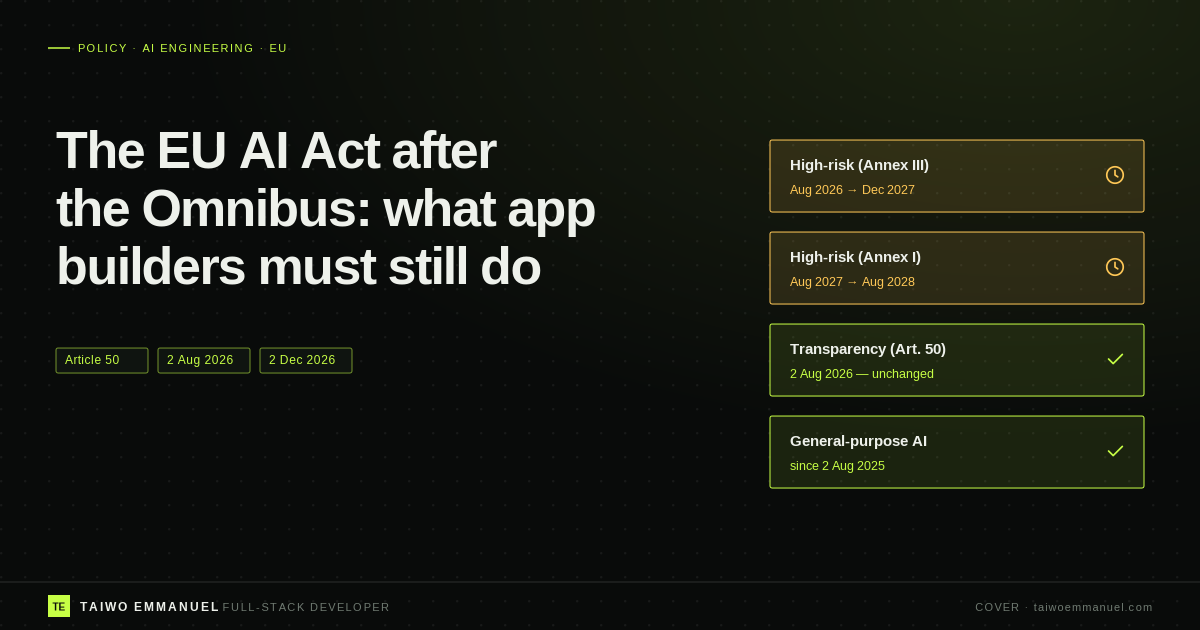
In 2026 the EU agreed a "Digital Omnibus" package that postponed parts of the AI Act, and a lot of teams read the headline as "the AI Act is delayed". It is not, at least not for the features most of us build. The postponement covers high-risk systems such as AI used in hiring, credit scoring or medical devices. The transparency rules in Article 50, which apply to ordinary chatbots, AI writing tools and image generators, kept their date of 2 August 2026.
I am a developer, not a lawyer, and this is not legal advice. It is an engineer's reading of what changed, what did not, and how I implement the duties that apply to typical AI features.
The problem: a delay that is narrower than it sounds
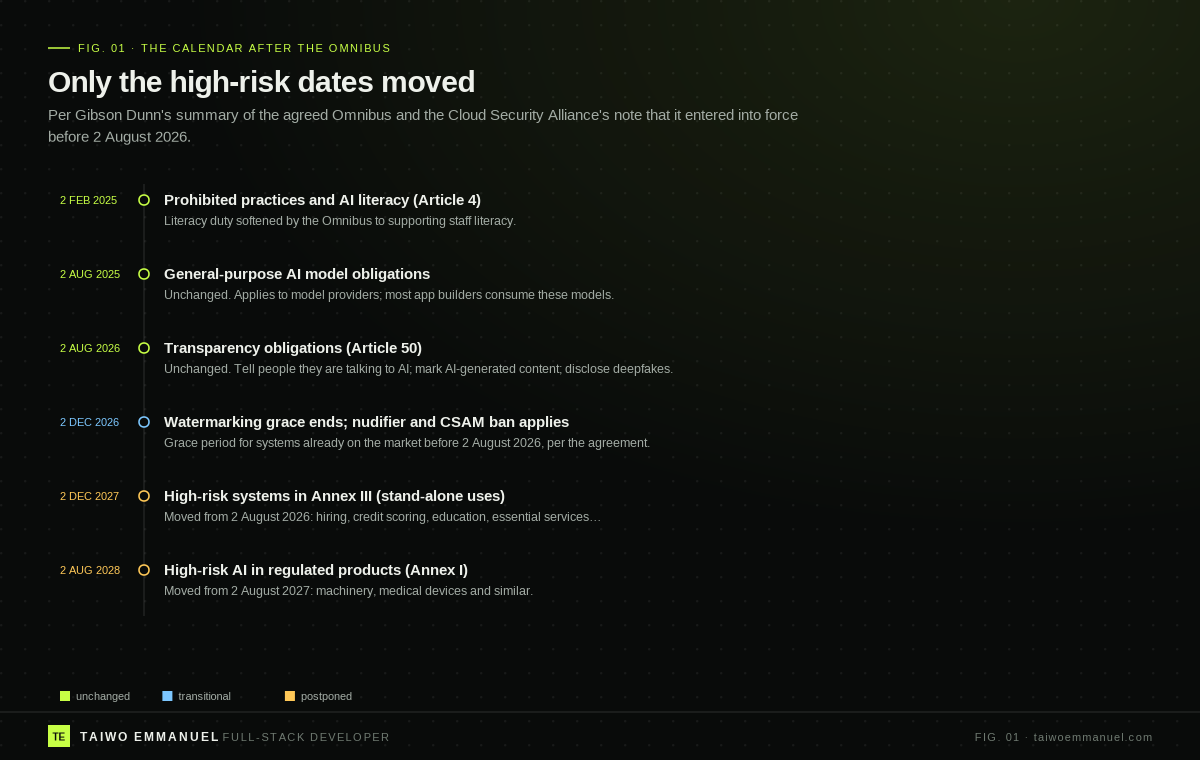
According to Gibson Dunn's summary of the political agreement, stand-alone high-risk systems listed in Annex III move from 2 August 2026 to 2 December 2027, and high-risk AI embedded in regulated products under Annex I moves from 2 August 2027 to 2 August 2028. The Cloud Security Alliance reported in early August that the Omnibus was in force before the original deadline.
What the same sources say did not move matters more to most product teams. Obligations for general-purpose AI model providers have applied since 2 August 2025. Article 50 transparency obligations proceeded from 2 August 2026. The agreement adds a grace period until 2 December 2026 for marking the output of systems already on the market before 2 August 2026, and a new prohibition on AI systems that generate non-consensual intimate imagery or child sexual abuse material, with its transitional period also ending on 2 December 2026.
The insight: transparency is a product feature, so build it like one
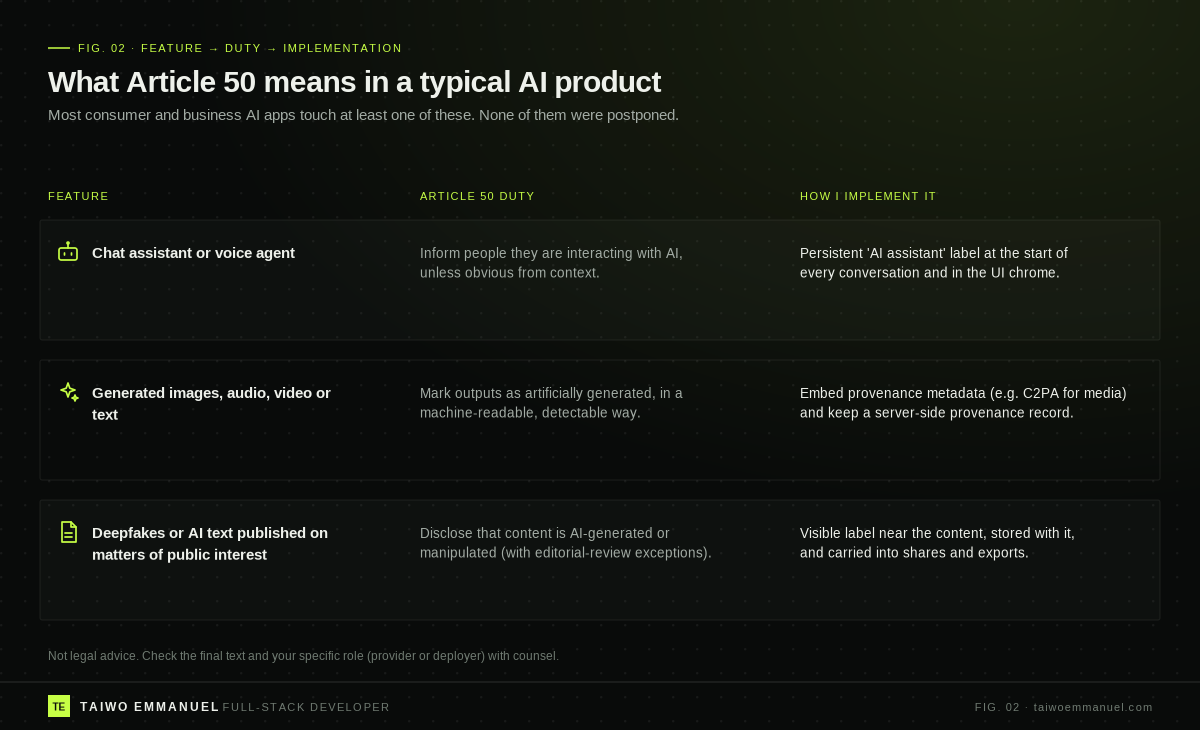
Article 50 boils down to three duties that map cleanly onto features. If people interact with an AI system, they must be told unless it is obvious. If your system generates synthetic images, audio, video or text, outputs must be marked as artificially generated in a machine-readable way. And deepfakes, plus AI-generated text published to inform the public on matters of public interest, must be disclosed, with an exception where a human has editorial responsibility.
Each of those is a UI and data-model decision, not a footnote in the terms of service. That is good news: we know how to build, test and ship UI and data models.
Implementation walkthrough
Step 1: a provenance record on every generated item
Whatever you store, store how it was made. This is the source of truth for every label, export and audit question later.
 TAIWO EMMANUEL / CODE NOTE
export type Provenance = {
  origin: "human" | "ai" | "ai-edited-by-human";
  model?: string;         // e.g. provider/model id used
  generatedAt?: string;   // ISO timestamp
  reviewedBy?: string;    // user id when a human took editorial responsibility
};

export type ContentItem = { id: string; body: string; provenance: Provenance };

export const needsAiLabel = (p: Provenance) => p.origin !== "human" && !p.reviewedBy;

// Machine-readable marking for text you serve over your API or embed in pages.
export const provenanceAttributes = (p: Provenance) => ({
  "data-ai-generated": p.origin === "human" ? "false" : "true",
  ...(p.model ? { "data-ai-model": p.model } : {}),
});
For images, audio and video, use an established content-credential format such as C2PA, which embeds signed provenance metadata in the file, rather than inventing your own. The server-side record above is still worth keeping: metadata can be stripped by other platforms, and you need your own audit trail regardless.
Step 2: disclosure components that cannot be forgotten
The simplest way to make disclosure reliable is to make it impossible to render AI content without it. Every place that shows generated content goes through one component.
TAIWO EMMANUEL / CODE NOTEimport { needsAiLabel, provenanceAttributes, type ContentItem } from "./provenance";
export function AiContent({ item }: { item: ContentItem }) {
return (
<article {...provenanceAttributes(item.provenance)}>
{needsAiLabel(item.provenance) ? (
<p className="ai-label" role="note">
AI-generated{item.provenance.model ? ` · ${item.provenance.model}` : ""}
</p>
) : null}
<div>{item.body}</div>
</article>
);
}
export function AssistantHeader() {
// Article 50(1): people must know they are interacting with an AI system.
return <header role="note" aria-label="About this assistant">You are chatting with an AI assistant. It can make mistakes.</header>;
}Step 3: carry the label into exports and shares
Copy buttons, downloads, email digests and share cards are where labels usually disappear. Add the disclosure at the boundary where content leaves your app.
TAIWO EMMANUEL / CODE NOTEimport { needsAiLabel, type ContentItem } from "./provenance";
export function toShareText(item: ContentItem) {
return needsAiLabel(item.provenance) ? `${item.body}\n\n(AI-generated content)` : item.body;
}
export function toExportJson(item: ContentItem) {
return JSON.stringify({ id: item.id, body: item.body, provenance: item.provenance }); // machine-readable
}
Takeaway
- The Digital Omnibus postponed high-risk obligations to 2 December 2027 (Annex III) and 2 August 2028 (Annex I).
- Article 50 transparency applied from 2 August 2026, and general-purpose AI duties have applied since August 2025.
- Systems already on the market before 2 August 2026 get until 2 December 2026 for output marking, per the agreement, and a new ban on nudifier and CSAM-generating systems applies from the same date.
- Build provenance into your data model, render AI content through one disclosure component, and carry labels into exports.
Dates reflect published summaries as of 2 November 2026. Confirm the final Official Journal text and your role (provider or deployer) with counsel.
References
- 1. EU AI Act Omnibus agreement: postponed high-risk deadlines and other key changes — Gibson Dunn, 27 May 2026
- 2. EU AI Act high-risk deadline pushed to December 2027 — Cloud Security Alliance, August 2026
- 3. Regulation (EU) 2024/1689 (Artificial Intelligence Act) — EUR-Lex
- 4. Article 50: Transparency obligations for providers and deployers of certain AI systems — EU AI Act explorer (Future of Life Institute)
- 5. Regulatory framework on AI — European Commission
- 6. Coalition for Content Provenance and Authenticity (C2PA) — C2PA