/WRITING · TECH & BUSINESS
Elon Musk's 2026: a $75 billion IPO and a car that briefly flew
In June SpaceX completed the largest IPO in history. In October a Tesla Roadster prototype jumped over five cars on rocket-style thrusters. Together they show the two sides of Musk's year: capital that moves at record speed and products that still move on their own schedule.
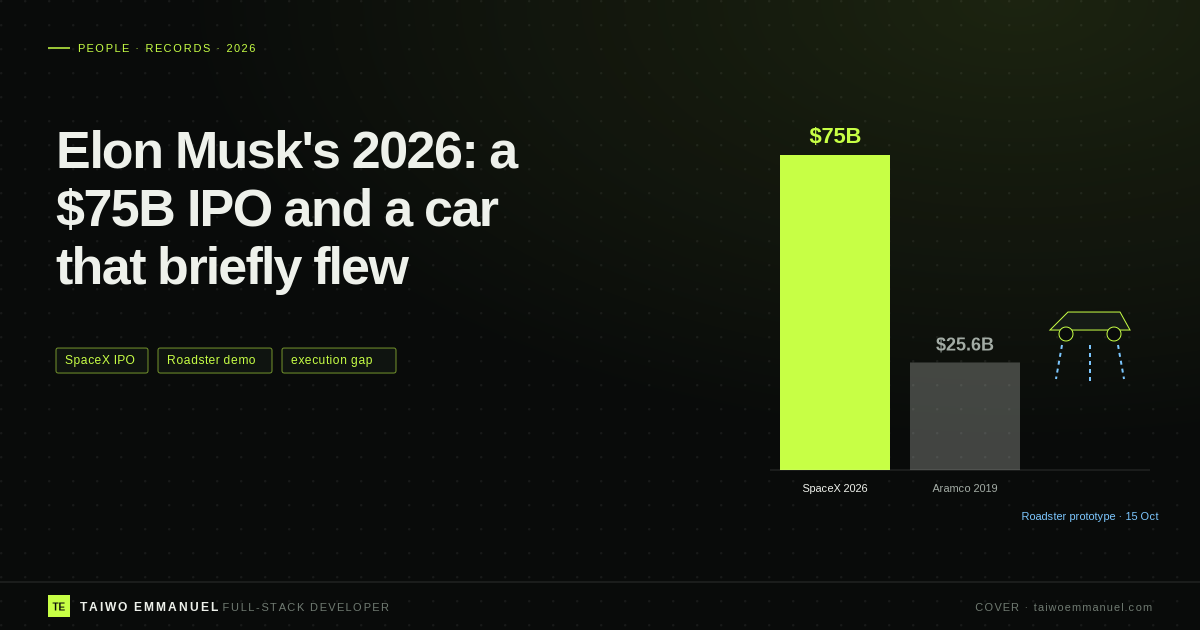
Few people generate as many headlines in a year as Elon Musk, and 2026 produced two that will outlast the news cycle. In June, SpaceX listed on Nasdaq in the largest initial public offering ever recorded. In October, at a SpaceX test facility in Texas, a prototype of the long-delayed Tesla Roadster drove off a ramp, cleared five parked cars and landed on cold-gas thrusters.
One is a capital-markets record measured in tens of billions of dollars. The other is a stunt measured in feet of air. Read together, they say something useful about how technology companies are financed and judged in 2026, and why builders should keep the two kinds of progress separate.
What happened
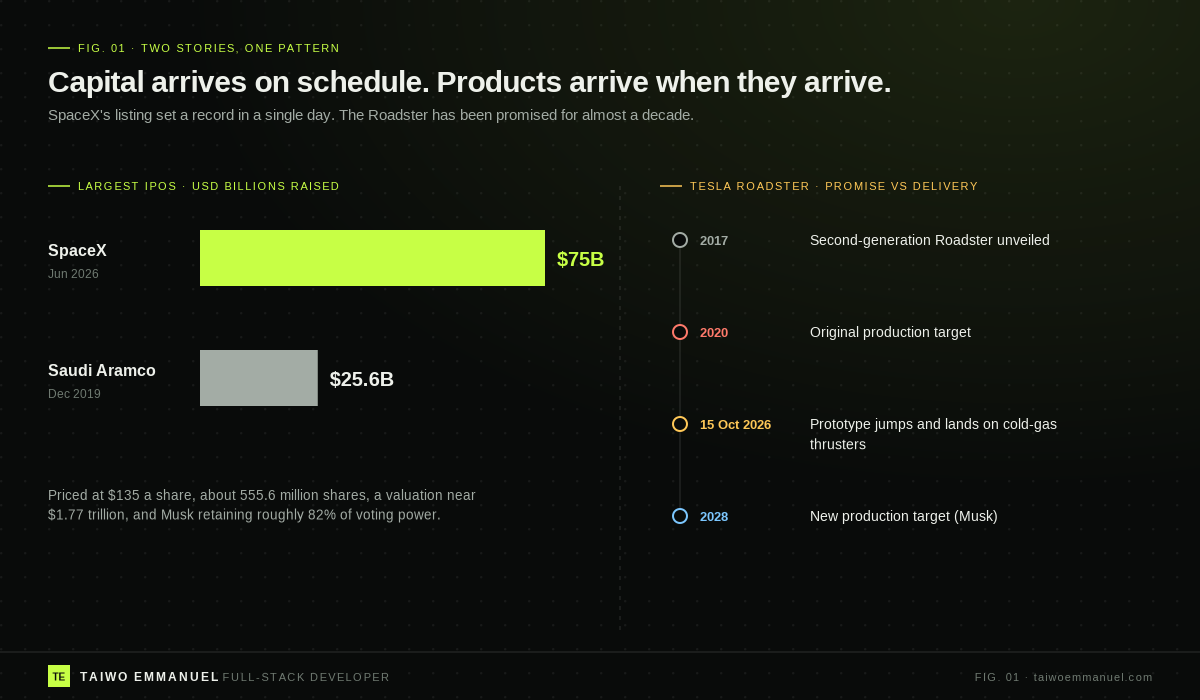
SpaceX priced its IPO at $135 a share and raised about $75 billion, according to Reuters and Nasdaq, with shares beginning to trade under the ticker SPCX on 12 June 2026. Reporting put the valuation at roughly $1.77 trillion at pricing, and the stock opened about 11% higher. The raise was nearly three times the previous record, Saudi Aramco's $25.6 billion listing in 2019. Musk retained around 82% of the voting power, so public investors bought economic exposure, not control.
Four months later, on 15 October, Tesla staged a product reveal at a SpaceX facility. NBC News reported that the prototype drove up a curved ramp, launched itself over five other Teslas and landed softly using cold-gas thrusters, later reaching about 27 feet during a barrel roll, according to Tesla. Musk said what the audience saw "was not AI or SI", admitted the car is "not necessarily a safety-optimized car", and said production will not begin until 2028. Tesla says the thruster-equipped Rocket version is not approved for public roads.
Why it matters
The IPO matters because of what it signals about appetite. A $75 billion raise required demand from institutions and retail investors at a scale never tested before, and reports said the book was close to four times oversubscribed. It also landed in the same fortnight as the other giant private companies made their moves: Anthropic filed confidentially for a listing on 1 June and OpenAI followed on 8 June. When the largest IPO in history clears easily, every late-stage company in that queue gets a live benchmark for demand.
The Roadster matters for a different reason. It was first unveiled in 2017 with production promised for 2020. The October demo was genuine engineering theatre, but it was a prototype doing a choreographed manoeuvre, with no price, a 2028 production target and a top configuration that cannot legally drive on public roads. NBC News also noted that the stated range target of 300 miles is less than half of the original promise.
None of this makes the demo meaningless. Cold-gas thrusters and a fan-based suction system on a road car are real hardware problems. But a demo answers the question "can this happen once, under controlled conditions?" Customers need answers to different questions: can it happen every day, safely, at a price, at scale?
A closer look
What makes Musk's companies unusual is that they run both scoreboards at once. SpaceX's valuation rests on businesses that already deliver at scale, most visibly Starlink, and on a track record of reusable launches. That operational base is why public investors were willing to pay for the future. The Roadster sits at the opposite end: a halo product whose value today is mostly attention.
For the rest of us building products, the pattern is familiar in miniature. A launch video, a waitlist or a funding announcement can arrive on schedule. The product arrives when the hard parts are solved. Teams that report the first as if it were the second lose trust with users, investors and their own engineers.
Takeaway
- SpaceX's roughly $75 billion IPO in June 2026 is the largest on record and reopened the door for other mega-listings.
- The October Roadster demo was a real prototype stunt, not a product: no price, production in 2028, and the flying version is not road-legal.
- Separate the scoreboard for capital and attention from the scoreboard for delivery. Both matter; only one ships.
This article reflects reporting available as of 2 November 2026.
References
- 1. SpaceX commences trading on Nasdaq after record $75 billion IPO — Nasdaq, June 2026
- 2. SpaceX raises $75bn in blockbuster IPO — Reuters via BusinessDay, 11 June 2026
- 3. SpaceX shares make Nasdaq debut after historic IPO — Business Today, 12 June 2026
- 4. Elon Musk shows off 'flying' Tesla Roadster after years of delays — NBC News, 16 October 2026
- 5. Elon Musk showcases 'flying car' Tesla Roadster at SpaceX facility — Interesting Engineering, October 2026
- 6. Following Anthropic, OpenAI files confidentially for IPO — TechCrunch, 8 June 2026